Does applying fast make a difference?
Short answer: yes. A surprising factor that quietly determines who gets shortlisted for NHS jobs, but most applicants overlook it entirely.
When a new NHS junior doctor vacancy goes live, applications often arrive immediately. Most roles receive dozens of applications within the first hour. It is not uncommon to see highly-contested junior roles close on the same day, once there are sufficient number of eligible applicants to shortlist.
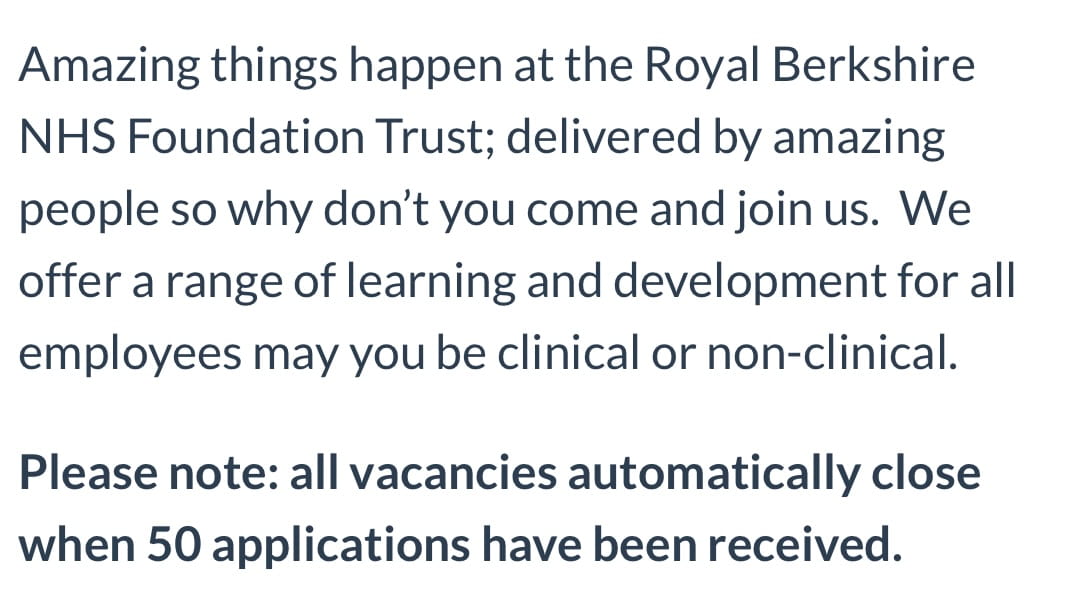
Above: Description from a job listing indicating that listing will be taken down after 50 applications
Our data shows that candidates who rely on manual refreshing of job boards apply to fewer roles, spend more time searching, and often miss short-lived opportunities entirely.
In contrast, candidates using instant job alerts apply faster, apply more often, and get seen earlier by recruiters.
Why Early Applications Get More Attention
Recruitment teams in the NHS often begin reviewing applications before a posting officially closes. In practice, this means shortlisting can start as soon as enough candidates appear in the system. Being among the first 10-20% dramatically increases your chances of being reviewed. This is especially important for candidates with zero NHS experience, who benefit from being seen before the job listings become saturated with applications.
- Early applicants are reviewed first. NHS recruitment teams often begin shortlisting long before the deadline.
- Late applicants are rarely seen. Even qualified candidates get overlooked if they apply after the initial surge.
- Speed levels the playing field. Even if you lack NHS experience, applying early gives you a fair chance before competition intensifies.
Why Manual Refreshing Doesn't Work Anymore
Many still rely on manual browsing of NHS job boards, checking only once or twice a day. Unfortunately, by the time they see a listing, hundreds of others already have. This delay is costly especially for NHS junior doctor roles, where trust-grade and junior clinical fellow posts fill extremely quickly.
Our internal data highlights this difference clearly:
- The fastest users that rely on manual refreshing take around an hour on average to discover a new listing.
- Users with instant alerts can successfully apply within 5 minutes of the job going live.
- Users subscribed to alerts apply to 3x more listings overall and spend far less time searching.
- Users subscribed to alerts consistently secure jobs in much less time, in as little as within a month.
How My NHS Job Alerts Transform Your Job Search
Instant alerts remove the need to constantly check job boards. Instead of chasing listings, the listings come to you. This allows you to apply quickly and consistently without wasting hours refreshing pages. A quick comparison between various methods of browsing:
- Manual checking: jobs may be discovered hours after posting.
- Email alerts: reduce delay, but still too slow, taking up to an hour or more.
- Instant alerts: reduce discovery time to near real-time, within minutes.
For candidates with zero NHS experience, this is one of the most effective ways to increase your chances. For current NHS junior doctors, it ensures you never miss fast-moving trust-grade or clinical fellow roles while at work. It can also signficantly reduce the amount of time you'll take to secure your next role.
Why Early Visibility Matters More for IMGs
International medical graduates often face additional layers of competition in NHS recruitment. While some qualifications are important, timing and visibility can influence whether an application even gets reviewed in the first place.
Being early in the applicant pool can help offset factors such as lack of prior NHS experience, because recruiters have not yet been exposed to large volumes of similar applications.
This is why many IMGs benefit from systems that prioritise speed of application.
- Early applications are less likely to be compared against saturated CV pools.
- Recruiters are more likely to review complete batches from the start.
- First impressions matter more when competition intensifies quickly.
You can also read more about how you can search for NHS junior doctor roles effectively.
The Bottom Line
Applying fast works. It gets your application seen earlier, increases your chances of being shortlisted, and helps you compete effectively.
If you want to maximise your chances of getting seen, the simplest and most powerful step you can take is to use instant alert services like My NHS Job Alerts instead of manually refreshing job boards.